


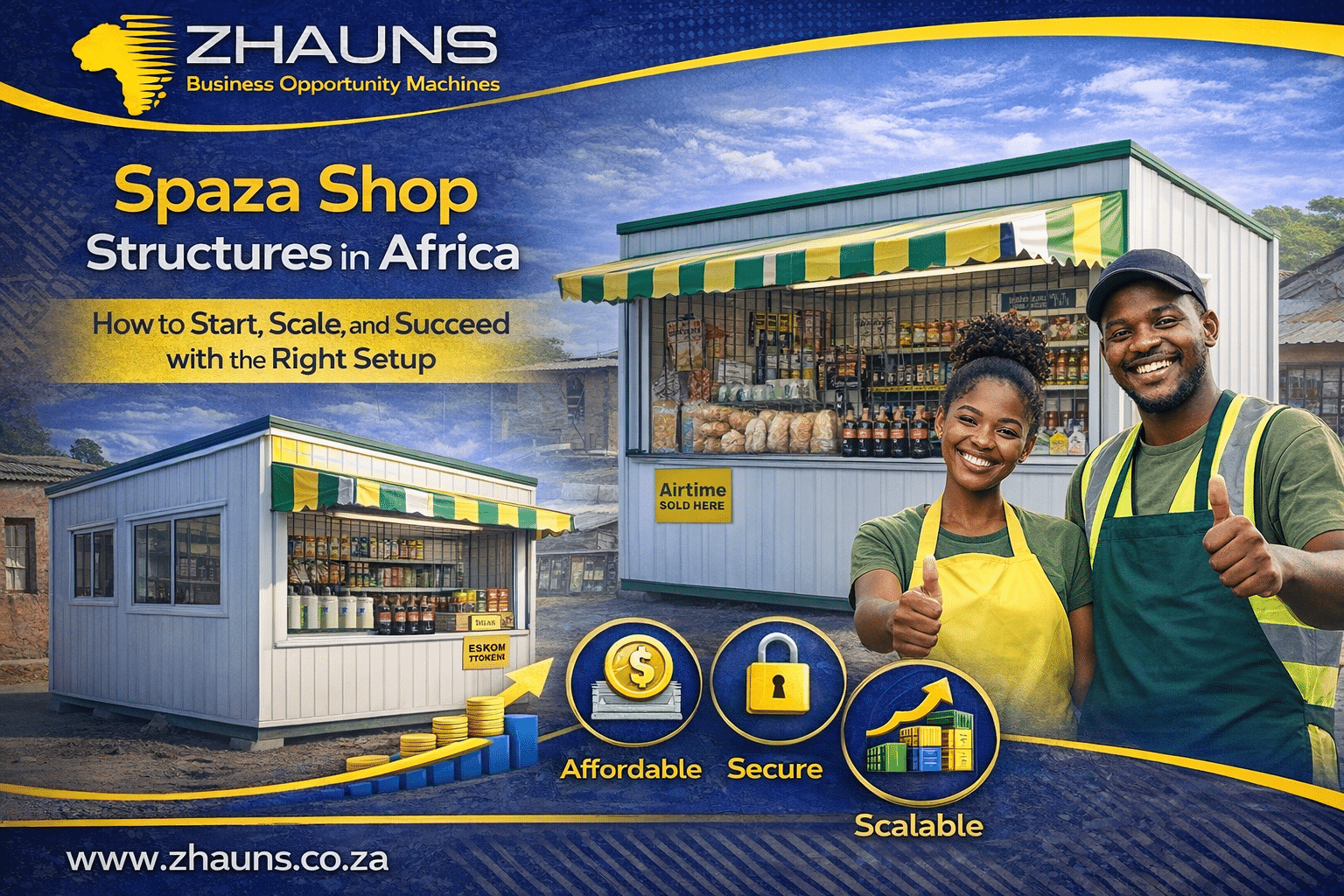
The Spaza Shop Is Africa’s Most Resilient Business Model
Walk through any township in Africa — Soweto, Khayelitsha, Mdantsane, or Umlazi — and one thing becomes immediately clear: the spaza shop is the backbone of community commerce.
Every single day, millions of people rely on these small, community-based stores for bread, milk, sugar, airtime, electricity tokens, and household essentials. They are open early. They are close to home. They understand their customers.
But here is the truth that many aspiring entrepreneurs overlook:
Most spaza shops fail not because of poor demand — but because of poor infrastructure.
A shop that leaks when it rains, has no security, or cannot store refrigerated goods will always struggle. This is exactly why more entrepreneurs across Africa and the wider African continent are turning to purpose-built container spaza shop structures — and why Zhauns has become a leading name in this space.
This guide covers everything you need to know: what makes a spaza shop succeed, which business models work best, how much it costs to get started, and how Zhauns spaza shop structures give entrepreneurs a real competitive advantage from Day 1.
What Is a Spaza Shop? (And Why It Still Works in 2026)
A spaza shop is a small, informal or semi-formal retail store that operates within a residential community, typically from a home, container, or dedicated structure. The term originates from South African township culture but the model exists across the continent under different names.
What makes the spaza shop model so durable?
Proximity beats price. Customers pay a small premium to avoid travelling long distances to a supermarket. Convenience is the product.
Low overhead keeps margins healthy. Without the rental and staffing costs of a formal retail store, a well-run spaza shop can generate meaningful daily profit.
Demand is non-negotiable. Bread, milk, cooking oil, airtime — these are not luxury goods. Regardless of the economic climate, communities always need essential goods nearby.
Flexible and adaptable. A spaza shop can evolve with community needs — from groceries to fast food, from airtime to mini hardware.
In Africa alone, there are an estimated 100,000 to 150,000 spaza shops actively trading. Yet the majority are still operating from informal structures that limit growth, compromise security, and reduce profitability.
The opportunity for entrepreneurs who invest in the right structure is enormous.
The #1 Barrier to Starting a Spaza Shop: Infrastructure
If you ask most aspiring spaza shop owners what is stopping them, the answer is rarely a lack of customers. It is almost always one of these:
- No suitable physical space to trade from
- Traditional construction is too slow and too expensive
- Renting a commercial property is unaffordable
- Existing home structures are not secure enough for business
Traditional brick-and-mortar construction in Africa involves:
- Architect fees and municipal approvals
- Construction timelines of 3 to 6 months or longer
- Costs that can easily exceed R80,000 to R200,000+
- Fixed structures that cannot be relocated if the market shifts
For a first-time entrepreneur with limited capital, this is a dead end.
This is where the Zhauns Modular spaza shop structures change everything.
Why Zhauns Spaza Shop Structures Are the Smarter Choice
A modular ( build up anywhere ) spaza shop structure is a purpose-built, pre-fabricated retail space designed specifically for African business environments.
Unlike traditional construction, these structures are:
Ready in days, not months. A Zhauns spaza shop structure can be installed and ready for trading within days of order — not months.
Significantly more affordable. The cost of a container spaza shop structure is a fraction of traditional construction, freeing up capital for stock and equipment.
Built for African conditions. Heat, dust, wind, and rain are accounted for. The Zhauns Spaza shop is fully insulated and will keep you cool in summer and warm in winter .These structures are durable and low-maintenance.
Fully customisable. Security Hatch for protection , windows, burglar-proofing, internal shelving, space for fridges and freezers — every feature can be tailored to your specific business model.
Relocatable. If your community shifts or a better location becomes available, your structure moves with you. A brick wall cannot do that.
Secure by design. Security doors, reinforced windows, and solid frames protect your stock and your income.
Explore the full range of spaza shop housing solutions here: Housing solutions Africa
7 Profitable Spaza Shop Business Ideas You Can Start Today
One of the most underrated advantages of a spaza shop is its versatility. With the right structure, you are not limited to one business model. Here are seven proven formats that South African entrepreneurs are using right now:
-
Grocery Spaza Shop (Most Common)
Stock daily essentials: bread, milk, eggs, rice, maize meal, cooking oil, sugar, canned goods, and snacks. Margins are modest but volumes are high and demand is daily.
Best location: Dense residential areas, near schools, along main routes.
-
Airtime and Electricity Shop
Prepaid electricity (Eskom tokens), mobile airtime for all networks, and mobile data bundles. Extremely low overhead and no spoilage risk.
Best location: Any high-foot-traffic residential area.
-
Fast Food Spaza Shop
Kotas, vetkoek, fried chips, pap and vleis, and local meals. Profit margins are significantly higher than retail goods. This model pairs well with small food production equipment.
Best location: Near taxi ranks, schools, factories, and lunch-hour foot traffic areas.
-
Tuck Shop at Schools and Institutions
Focused stock for learners: snacks, cold drinks, sweets, stationery, and hot food. Predictable daily volumes during school terms.
Best location: Inside or adjacent to school premises.
-
Mini Salon or Barber Shop
Combine a small retail section (hair products, toiletries) with grooming services. Increases income from multiple streams within a single structure.
Best location: Residential areas with limited salon access.
-
Mini Hardware and Building Supplies Shop
Tools, paint, nails, screws, sandpaper, and small building materials. This niche has less competition than grocery and serves a consistent market of home builders and contractors.
Best location: Areas with active informal construction and home improvement.
-
Hybrid Retail and Production Shop
This is the most powerful model. Sell products AND produce them. For example: sell vetkoek and pap while also making your own snacks or packaged goods using affordable manufacturing equipment.
From Spaza Shop to Small Manufacturer: The Profit Multiplier Strategy
Most spaza shop owners think of themselves as retailers. The entrepreneurs who grow fastest think of themselves as producers who also retail.
Here is why this matters:
When you buy and sell a packet of chips, your margin might be R1–R2. When you make and sell a packet of chips, your margin can be R5–R10 or more.
The difference is manufacturing — and it does not have to be complex.
With the right small-scale production equipment, a spaza shop owner can:
- Produce their own packaged snacks and sell them in-store and to other shops
- Make their own cooking oil, peanut butter, or spices
- Bake and sell bread, vetkoek, or rusks on-site
- Package and brand their own products at a competitive price
This creates multiple income streams from a single structure — higher margins, more control over supply, and a growing brand.
How Much Does It Cost to Start a Spaza Shop in South Africa?
This is the question every aspiring entrepreneur asks. The honest answer: it depends on your setup — but it is far more accessible than most people assume.
Here is a rough breakdown of what to budget for:
Structure cost: This varies based on the size, features, and customisation of your Zhauns container or modular structure. Contact Zhauns directly for a quote tailored to your needs via Zhauns Housing.
Opening stock: A basic grocery spaza shop can open with R5,000 to R15,000 worth of stock. Airtime and electricity shops require very little upfront inventory cost.
Equipment: A fridge or freezer for cold drinks, ice cream, or dairy products. If running a food shop, a gas stove or fryer.
Licensing: In South Africa, you may need a business licence and, for food sales, a Certificate of Acceptability from your local municipality. Costs are minimal but check your local authority requirements.
Signage and branding: A well-branded shop builds trust and attracts customers. Budget for a basic board or signage from the start.
The key advantage of starting with a Zhauns structure is that your infrastructure cost is known upfront, fixed, and far lower than traditional construction — meaning more capital is available for stock, equipment, and working capital.
Location Strategy: Where to Place Your Spaza Shop for Maximum Sales
Even the best-equipped spaza shop will underperform in the wrong location. Here are the proven location principles used by successful spaza shop owners:
High foot traffic is non-negotiable. Position near taxi ranks, bus stops, schools, community halls, or along main pedestrian routes.
Residential density matters. Areas with dense informal or formal housing have the highest daily need for essential goods.
Reduce distance to the next closest shop. Your competitive edge is convenience — the fewer alternatives within walking distance, the stronger your position.
Visibility helps. A shop that can be seen from the road or from a distance attracts passing customers.
Consider mobility. Because Zhauns structures are portable, you can test a location before committing long-term. This is a significant advantage over any fixed building.
Supporting Youth Entrepreneurs: The Zhauns Youth Initiative
Youth unemployment remains one of South Africa’s most serious economic challenges. The spaza shop model — particularly when supported by affordable infrastructure — offers young people a practical, low-risk pathway into business ownership.
Through dedicated youth support programmes, Zhauns helps young entrepreneurs:
- Access affordable business structures with lower capital barriers
- Learn practical business skills from setup through to daily operations
- Reduce financial risk during the critical early months of trading
- Build long-term income and financial independence
If you are a young entrepreneur looking to start your first business, explore the Zhauns Youth programme:
The Community Economic Impact of Spaza Shops
A spaza shop is not just a business. It is a community asset.
Every well-run spaza shop in a township or rural community:
- Reduces household travel costs. When families can buy essentials within walking distance, they save money on transport.
- Creates local employment. As shops grow, owners hire assistants, creating jobs within the community.
- Supports local suppliers. Many spaza shop owners source fresh produce and goods from local growers and manufacturers.
- Keeps money circulating locally. Rands spent at a community spaza shop are far more likely to recirculate within that community than rands spent at a distant supermarket.
- Provides financial resilience. For many families, the income from a spaza shop is the primary or supplementary household income.
One small container shop with the right structure and stock can directly support two to three households — and generate wider economic activity beyond that.
Why Modular and Portable Structures Are the Future of African Retail
Africa’s markets are not static. Communities grow. Infrastructure changes. Populations shift. The entrepreneur who builds a fixed, expensive structure in the wrong place has a serious problem.
Modular and container-based retail structures solve this permanently.
They can be:
- Relocated if your market moves
- Expanded by adding additional units as your business grows
- Upgraded with new features without starting from scratch
- Deployed in rural or peri-urban areas where traditional construction is impractical
This flexibility is especially important in South Africa’s fast-changing informal settlement landscape, where community growth and infrastructure development can rapidly alter trading conditions.
For entrepreneurs who want to build a business that can adapt and grow, a Zhauns modular structure is the logical choice.
How to Get Started with Your Zhauns Spaza Shop Structure
The process of starting your spaza shop with Zhauns support is straightforward:
Step 1: Choose your business model. Decide whether you are starting a grocery shop, fast food outlet, airtime shop, hybrid model, or another format. This determines which structure size and features you need.
Step 2: Select your structure. Visit Zhauns Housing Solutions to explore structure options and request a quote based on your specific requirements.
Step 3: Identify your location. Apply the location strategy principles covered above. Remember — Zhauns structures are relocatable, so you can adjust if needed.
Step 4: Secure your opening stock. Start with fast-moving essentials and expand your range as cash flow improves.
Step 5: Consider manufacturing. Explore whether small-scale production equipment from Zhauns Machine can increase your margins from Day 1.
Step 6: Register and license your business. Check your local municipality for licensing requirements. Keep records from the start.
Frequently Asked Questions About Spaza Shops in South Africa
Q1: How much does it cost to start a spaza shop in South Africa?
Starting costs vary depending on your setup. A basic airtime and electricity spaza shop can begin with as little as R3,000–R5,000 in stock. A grocery spaza shop typically requires R8,000–R20,000 in opening stock. The biggest variable is your structure — a Zhauns container spaza shop structure is significantly more affordable than traditional construction and can be quoted directly at
Q2: Do I need a licence to operate a spaza shop in South Africa?
Yes. South African law requires informal traders and spaza shop operators to hold a trading licence or business licence issued by their local municipality. If you sell food, you will also need a Certificate of Acceptability from the Environmental Health department. Requirements vary by municipality, so contact your local authority for exact requirements.
Q3: What is the most profitable type of spaza shop?
The most profitable spaza shops typically combine retail with some form of production or service. A fast food spaza shop generally has higher margins than a pure grocery shop. A hybrid shop that sells packaged goods it also manufactures — using equipment from Zhauns — generates the highest margins because it eliminates middlemen in the supply chain.
Q4: What is the difference between a spaza shop and a tuck shop?
In South Africa, the terms are often used interchangeably. Technically, a tuck shop often refers to a smaller operation targeting school learners with snacks and confectionery, while a spaza shop is broader — serving full community retail needs. Both can operate from a Zhauns container structure.
Q5: Can I run a spaza shop from a shipping container?
Yes. Container-based spaza shop structures are increasingly popular across Africa because they are secure, durable, affordable, and fast to deploy. Zhauns offers purpose-built container and modular structures specifically designed for retail operations. Visit https://zhauns.co.za/zhauns-housing-solution/ for options.
Q6: How long does it take to set up a Zhauns spaza shop structure?
Unlike traditional construction which can take months, a Zhauns modular or container spaza shop structure can typically be installed and ready for trading within days. This dramatically reduces the time between investing and earning.
Q7: Can I expand my spaza shop as my business grows?
Yes. One of the key advantages of modular container structures is scalability. You can add additional units, expand your serving area, or upgrade features as your revenue grows — without rebuilding from scratch.
Q8: What products sell best in a South African spaza shop?
The fastest-moving products in South African spaza shops include bread, milk, cooking oil, maize meal, eggs, sugar, rice, cold drinks, airtime, prepaid electricity tokens, snacks, and cigarettes. Fast food items — particularly kotas and fried chips — also sell consistently well in township environments.
Q9: Is the spaza shop business still profitable in 2026?
Yes. Despite competition from larger retailers, the spaza shop remains highly profitable for operators who choose good locations, manage stock correctly, and invest in proper infrastructure. The convenience factor, community relationships, and adaptability of the format continue to make it one of Africa’s most resilient business models.
Q10: How can young people get started in the spaza shop business?
Zhauns has a dedicated youth support initiative designed to lower the barriers to entry for young entrepreneurs. Explore the programme at zhauns-youth to understand the support, guidance, and infrastructure options available specifically for youth-owned businesses.
Your Spaza Shop Starts With the Right Foundation
The spaza shop is not a relic of the past. It is one of the most powerful, accessible, and community-driven business models in Africa — and it is evolving rapidly.
Entrepreneurs who invest in the right infrastructure from the start — a secure, customisable, relocatable container structure from Zhauns — do not just open a shop. They build a business platform that can grow into manufacturing, expand into multiple locations, and create lasting income.
The difference between a struggling spaza shop and a thriving one is rarely the product range. It is the foundation.