


South Africa has a problem that millions of people feel every single day: not enough buildings, built too slowly, at too high a cost.
The government’s own data tells the story. Housing completions collapsed from over 235,000 units in 1998-99 to just 34,000 in 2022-23. At the same time, South Africa’s urban population is expanding at 2% per year, and by 2030, 71% of all South Africans will live in cities. The gap between supply and demand is widening — fast.
This is exactly why prefabricated buildings, modular buildings, and prefab construction are no longer niche options. They are becoming the mainstream answer to one of the country’s most urgent infrastructure challenges.
And for entrepreneurs, business owners, schools, community organisations, and developers — the opportunity to use prefab buildings smartly has never been more accessible, more affordable, or more powerful than it is right now.
What Are Modular / Prefabricated Buildings? (And Why the Terminology Matters)
Before we go further, let’s clear up the terminology, because the terms are often used interchangeably — but there are meaningful differences.
Prefabricated buildings (prefab buildings): Any structure where components are manufactured off-site in a factory and then transported to the final location for assembly. This is the broadest category.
Modular buildings: A specific type of prefab construction where complete ‘modules’ or sections of a building are fully assembled in the factory — including walls, floors, ceilings, and finishes — and then connected on-site. Modular buildings lead the South African market with 58.2% market share.
Panelised prefab: Flat panels (walls, roofs, floors) are made in the factory and assembled on-site. Faster than traditional construction but requires more on-site work than modular.
For most entrepreneurs and businesses in the Zhauns context, the relevant category is modular — purpose-built units that arrive largely complete and are ready to use within days of installation.
Why Modular / Prefab Buildings Are Booming in South Africa Right Now
The South African prefabricated buildings market is not just growing — it is accelerating. The market is estimated at USD 4.21 billion in 2025 and is projected to reach USD 6.22 billion by 2030, growing at an 8.12% CAGR.
What is driving this? Several factors are converging simultaneously:
- The Housing Crisis Is Getting Worse, Not Better
South Africa has a housing deficit of approximately 2.3 million units. Traditional construction simply cannot close this gap at the required speed or cost. Prefab reduces delivery timelines from 18-24 months to 6-9 months — a critical advantage for municipalities, developers, and individuals.
- Load Shedding Has Changed What People Want
Chronic electricity disruptions have pushed demand for solar-integrated modular buildings that can operate off-grid. Factory-fitted photovoltaic roofs and battery storage are increasingly standard features in premium modular units.
- Government Programmes Are Backing Prefab
In January 2025, President Cyril Ramaphosa launched a USD 55.6 million Northern Cape project for 4,000 modular homes — to be completed within 18 months. Performance-based public tenders now reward companies that can guarantee delivery timelines, channelling contracts toward modular manufacturers.
- Cost of Traditional Construction Is Rising
Material inflation and labour shortages have made conventional building increasingly expensive. Prefab locks in material costs at the factory, reduces waste, and cuts on-site labour requirements significantly.
What Can Prefab and Modular Buildings Be Used For?
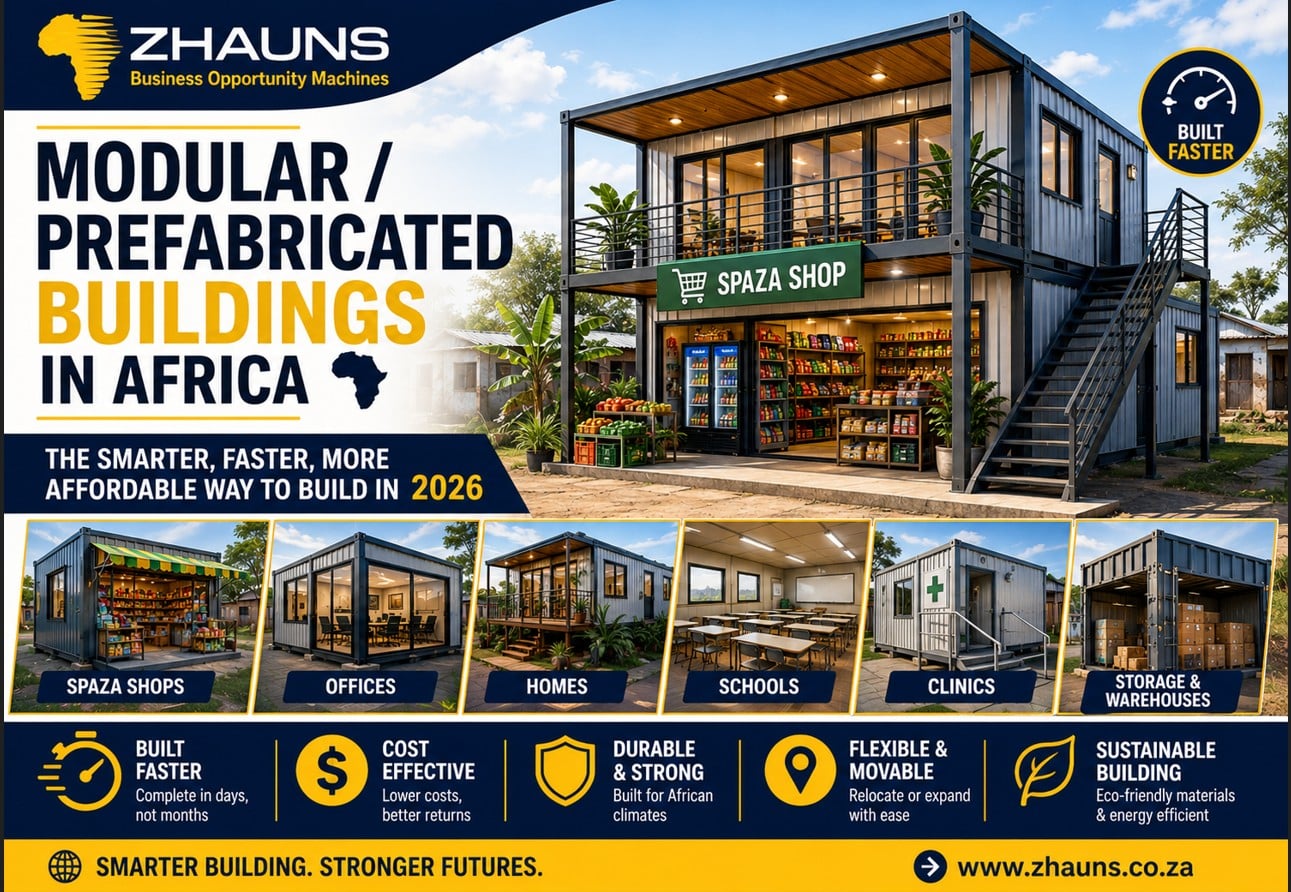
The versatility of prefab is one of its strongest selling points. Here are the most common applications in the South African context:
- Residential homes — from affordable housing to premium off-grid homes
- Spaza shops and retail structures — community-based commerce
- Offices and commercial buildings — corporate, mining, energy sector
- Schools and classrooms — fast-deployment educational infrastructure
- Clinics and healthcare facilities — rural and peri-urban health infrastructure
- Accommodation camps — mining, construction, and remote workforce housing
- Hybrid structures — shop below, accommodation above
- Storage facilities and warehouses
For entrepreneurs, the most relevant applications are retail structures (spaza shops, kiosks, fast food), hybrid live-work buildings, and small business premises — all of which Zhauns specialises in.
Explore Zhauns housing and retail structures
Key Benefits of Prefabricated Buildings Over Traditional Construction
Speed
A modular building can be manufactured in the factory in as little as 3 days, with full structures erected at a rate of 12.5 m² per day. Compare that to brick-and-mortar construction timelines of 3-12 months and the advantage is obvious.
Cost Certainty
With prefab, you know your cost upfront. Factory production eliminates most of the cost overruns that plague traditional site-based construction. This is critical for entrepreneurs and small businesses managing limited capital.
Durability
Modern prefab buildings are engineered for South African conditions — heat, dust, wind, and rain. Steel-clad, insulated panels resist mould, termites, rust, and rot. A 2025 study confirmed that modular buildings can last decades with proper upkeep and have significantly lower material fatigue than traditional construction.
Relocatability
Unlike a brick wall, a modular building can move. If your business location changes, your building goes with you. This is a transformative advantage for entrepreneurs in dynamic township and peri-urban markets.
Sustainability
Factory production generates significantly less waste than site construction. Modular buildings consume up to 67% less energy during the build phase. For environmentally conscious businesses and green-building mandates, prefab is increasingly the preferred option.
Prefab Buildings and Business: The Zhauns Advantage
For entrepreneurs who want to start a business — a spaza shop, a fast food outlet, a hybrid retail and accommodation structure, or a community service centre — Zhauns offers purpose-built prefab solutions designed specifically for African business environments.
These are not generic containers or repurposed storage units. They are business-optimised structures with:
- Serving hatches and windows for retail operations
- Security doors and burglar-proofing
- Internal shelving and layout options
- Space for fridges, freezers, and commercial equipment
- Custom branding and signage options
- Insulation for year-round comfort
- Options for upper-level accommodation or storage
View full range of Zhauns modular structures
Add production capability with Zhauns manufacturing machines
How Much Do Prefabricated Buildings Cost in Africa?
Prefab building costs in South Africa vary widely based on size, material type, finish level, and application. As a general guide:
- Small retail or kiosk structures (3m-6m): More affordable entry point, ideal for first-time entrepreneurs
- Medium commercial or residential units (6m-12m): Suitable for spaza shops, offices, and starter homes
- Large modular structures or multi-unit complexes: Industrial, mining, and institutional applications
The key is that prefab almost always costs significantly less than equivalent traditional construction — and delivers faster. Contact Zhauns directly for a quote tailored to your specific application and site requirements.
Frequently Asked Questions: Prefabricated Buildings South Africa
Q: Are prefab buildings permanent or temporary?
Both. Modern prefab buildings can be designed as permanent, fixed structures or as relocatable units. For business use, the ability to relocate is often an advantage — not a limitation.
Q: Can I get a home loan or bond on a prefab house in South Africa?
Yes, but with conditions. FNB and Nedbank are open to financing prefab homes that meet National Building Regulations and are fixed to a foundation. Requirements vary — consult your bank directly.
Q: How long does a prefab building last?
With proper upkeep, modular buildings can last decades. High-quality materials including steel-clad insulated panels resist the elements and require minimal maintenance over their lifetime.
Q: Do prefab buildings comply with South African building regulations?
Leading prefab manufacturers in South Africa hold Agrement South Africa, NHBRC, and CIDB certifications. Always verify compliance for your specific application and municipality.
Q: What is the difference between a prefab building and a container conversion?
A container conversion uses a repurposed shipping container as its base. A purpose-built prefab building is designed and manufactured from scratch for its intended use — typically offering better insulation, finish quality, and customisation. Zhauns offers purpose-built modular structures designed specifically for business and residential use.
Prefab Is No Longer the Alternative — It’s the Mainstream
With a market projected to grow from USD 4.21 billion to USD 6.22 billion by 2030, prefabricated and modular buildings are reshaping how South Africa builds.
For entrepreneurs, the message is simple: you do not have to wait months for a building, spend a fortune on construction, or risk being stuck in the wrong location. A purpose-built Zhauns prefab structure gives you a professionally designed business space in days — not months.
That is the future of African construction. And it is available right now.