


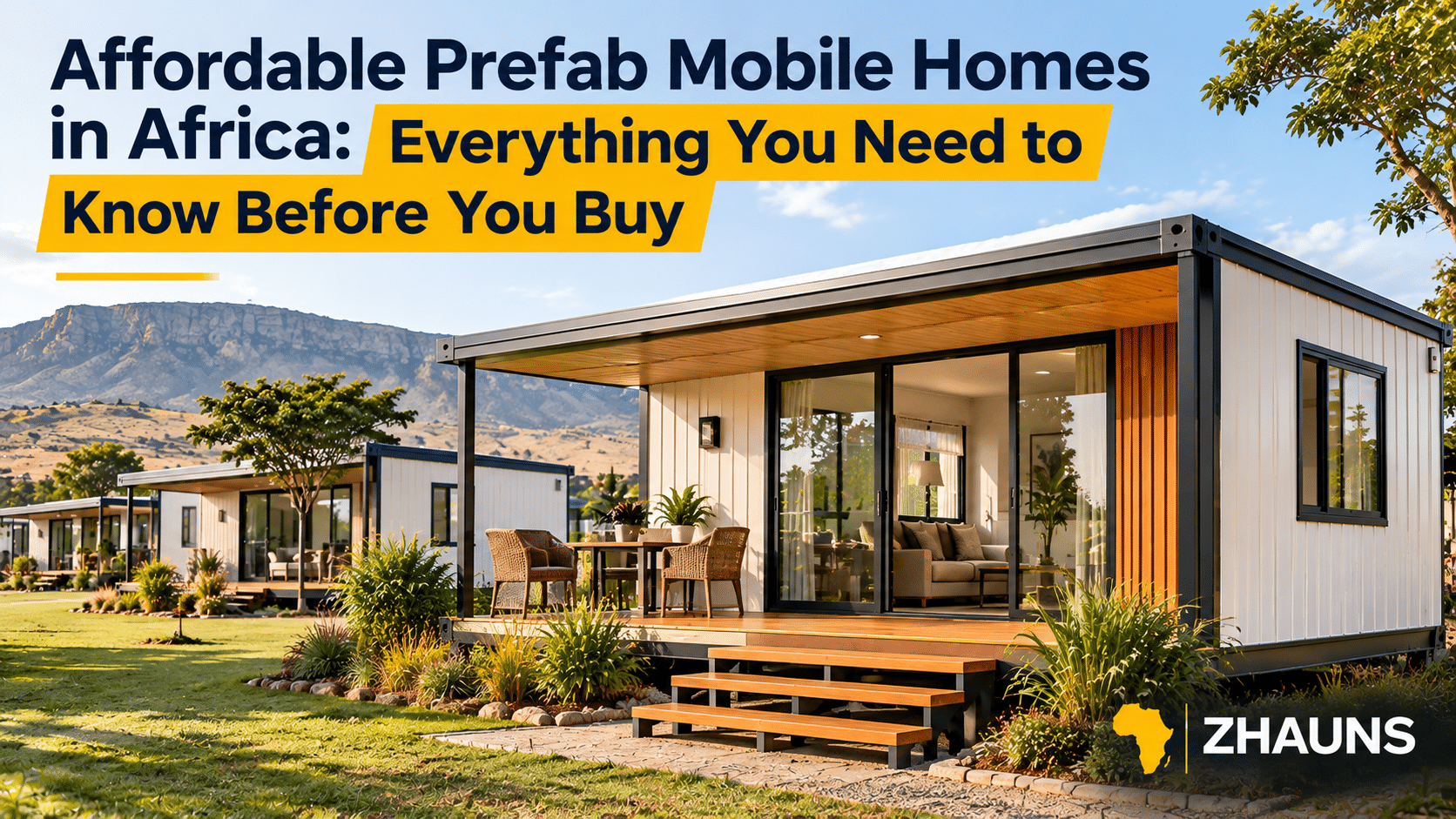
The housing backlog across sub-Saharan Africa runs into the millions. Traditional brick-and-mortar construction is slow, expensive, and often inaccessible to families in rural and peri-urban areas. Affordable prefab mobile homes Africa are changing this reality — offering quality, permanent-feel living spaces that can be delivered and installed in days rather than months.
This comprehensive guide covers what prefab mobile homes are, how they compare to conventional construction, who they suit, what they cost, and the questions buyers ask most often.
What Is a Prefab Mobile Home?
A prefab (prefabricated) home is built in a factory, transported to your site in panels or modules, and erected on a prepared foundation. Unlike a caravan or temporary structure, a quality prefab home is a permanent dwelling — insulated, weatherproof, secure, and designed to last 25–40 years.
Zhauns builds two main types: the Fold-Out home (erected in 12–48 hours using a crane or a small team) and the Build-Out home (assembled panel by panel over 5–7 days). Both use the same heavy-gauge galvanised steel frame and insulated sandwich panels as our portable buildings Africa commercial range — built to the same standard, just designed for residential living.
Why Are Prefab Homes Growing So Fast in Africa?
- Speed: A prefab home can be ready for occupation in days. A brick house takes 6–12 months minimum.
- Cost certainty: You receive a fixed quote. No hidden costs, no material price escalations mid-build.
- Quality control: Manufactured in a controlled factory — no rain delays, no skill variations between bricklayers.
- Relocatability: If your circumstances change, the home can be dismantled and moved. Brick houses cannot.
- Rural suitability: No need for skilled local tradespeople. Our team handles delivery and erection.
The result is a product that suits a first-time buyer in a rural area just as well as a property investor adding units to a township development. Our prefab housing units Africa are currently deployed across Africa, including Zimbabwe, Zambia, Mozambique, and beyond.
How Much Does a Prefab Mobile Home Cost in Africa?
Pricing starts from R89,900 for an entry-level unit. Final cost depends on size, configuration, and optional features. As a starting reference:
| Home Size | Dimensions (L × W × H) | Pricing |
| Studio / bachelor | 5,900mm × 3,000mm × 2,800mm | From R89,900 |
| 1-bedroom | Custom size available | Contact for quote |
| 2-bedroom | Custom size available | Contact for quote |
| 3-bedroom | Custom size available | Contact for quote |
| Multi-unit / family home | Custom size available | Contact for quote |
Prices include the structure, insulated panels, windows, doors, electrical conduit, and basic fit-out. Foundation, site preparation, plumbing connections, and internal finishes are typically quoted separately. Contact Zhauns for a personalised site-specific quote.
Prefab vs Brick House: Which Is Better for African Conditions?
| Factor | Prefab Home | Brick House |
| Build time | Days to weeks | 6–18 months |
| Price certainty | Fixed quote | Variable — overruns common |
| Thermal performance | Insulated panels — cool in summer, warm in winter | Depends heavily on wall thickness and spec |
| Durability | 25–40 years with maintenance | 40+ years if well built |
| Relocatability | Yes | No |
| Rural access | Delivery by truck, erection by small team | Requires local skilled labour + materials transport |
| Flood / fire risk | Steel frame — no rot, no termites | Brick can crack, plaster absorbs water |
For most buyers in Africa comparing these two options honestly, prefab wins on speed, cost certainty, and accessibility. Brick wins only on long-term resale perception in some urban markets — and even this gap is narrowing as mobile homes accommodation Africa gain mainstream acceptance.
What Sizes Are Available?
Zhauns manufactures prefab homes from compact 18m² bachelor units to large 96m² family homes. Custom sizes are available for developers and bulk buyers. All units can be connected side by side or stacked in a double-storey configuration.
Popular configurations include:
- Bachelor / studio — ideal for security guards, farm workers, domestic staff accommodation
- 2-bedroom — the most popular family unit for rural and peri-urban residential use
- 3-bedroom — standard family home replacement, fully comparable to a small brick house
- Multi-unit row houses — for developers, mining companies, and residential estate projects
Are Prefab Homes Insulated for African Climates?
Yes — this is a common concern and it is addressed by design. All Zhauns homes use 75mm or 100mm insulated sandwich panels (the same specification used in our mobile clinic structures Africa), which maintain internal temperatures 8–12°C cooler than ambient in summer and significantly warmer than uninsulated structures in winter.
The galvanised steel roof also features a heat-reflective coating on selected models. Units deployed in the Limpopo bushveld, the Karoo, and coastal Mozambique all perform comfortably without air conditioning in most seasons.
What Happens After Delivery? Installation Explained
Our standard installation process:
- Site assessment — our team visits to check access, foundation requirements, and service connections
- Foundation preparation — a concrete slab or strip foundation is laid (can be done by your contractor or ours)
- Delivery — the home arrives flat-packed on a flatbed truck
- Erection — the Fold-Out method takes 12–48 hours; the Build-Out method takes 5–7 days
- Fit-out — electrical connections, door locks, windows are completed and checked
- Handover — you receive keys and a 5-year structural warranty document
Frequently Asked Questions
Q: How long will a prefab mobile home last?
A: With normal maintenance (annual inspection, touch-up paint on any scratches, gutter clearing), a Zhauns prefab home lasts 25–40 years. The galvanised steel frame does not rot, warp, or crack. Panels can be individually replaced if damaged by impact.
Q: Can I extend or renovate a prefab home later?
A: Yes. Additional rooms can be added as bolt-on modules. Internal walls can be repositioned. Solar panels, water tanks, and carports can all be added after erection.
Q: Is a prefab home safe in high winds or storms?
A: Zhauns homes are engineered to withstand wind loads consistent with African climatic zones. The steel frame is bolted to the foundation and will not shift in normal storm conditions. For areas with extreme weather, our team can advise on additional anchoring. See our full range at the Zhauns mobile homes page.
Q: Do you deliver to rural areas?
A: Yes. We deliver across Africa, including Zimbabwe, Zambia, Botswana, Namibia, and Mozambique. Our portable buildings Africa logistics team handles cross-border documentation for SADC deliveries.
Who Should Buy a Prefab Mobile Home?
- First-time homeowners who cannot afford a brick build but want a permanent residence
- Farmers needing worker accommodation or a manager’s home on a remote property
- Property investors adding rental units to a sectional title or township development
- Mining and construction companies needing staff housing near a project site
- NGOs and development organisations building housing for beneficiary communities
- Families needing a temporary home while their main house is built or renovated
Whatever your reason, the key advantage is the same: a quality home, faster and more affordably than any alternative. Explore our full range of prefab housing units Africa or contact us for a no-obligation quotation.