


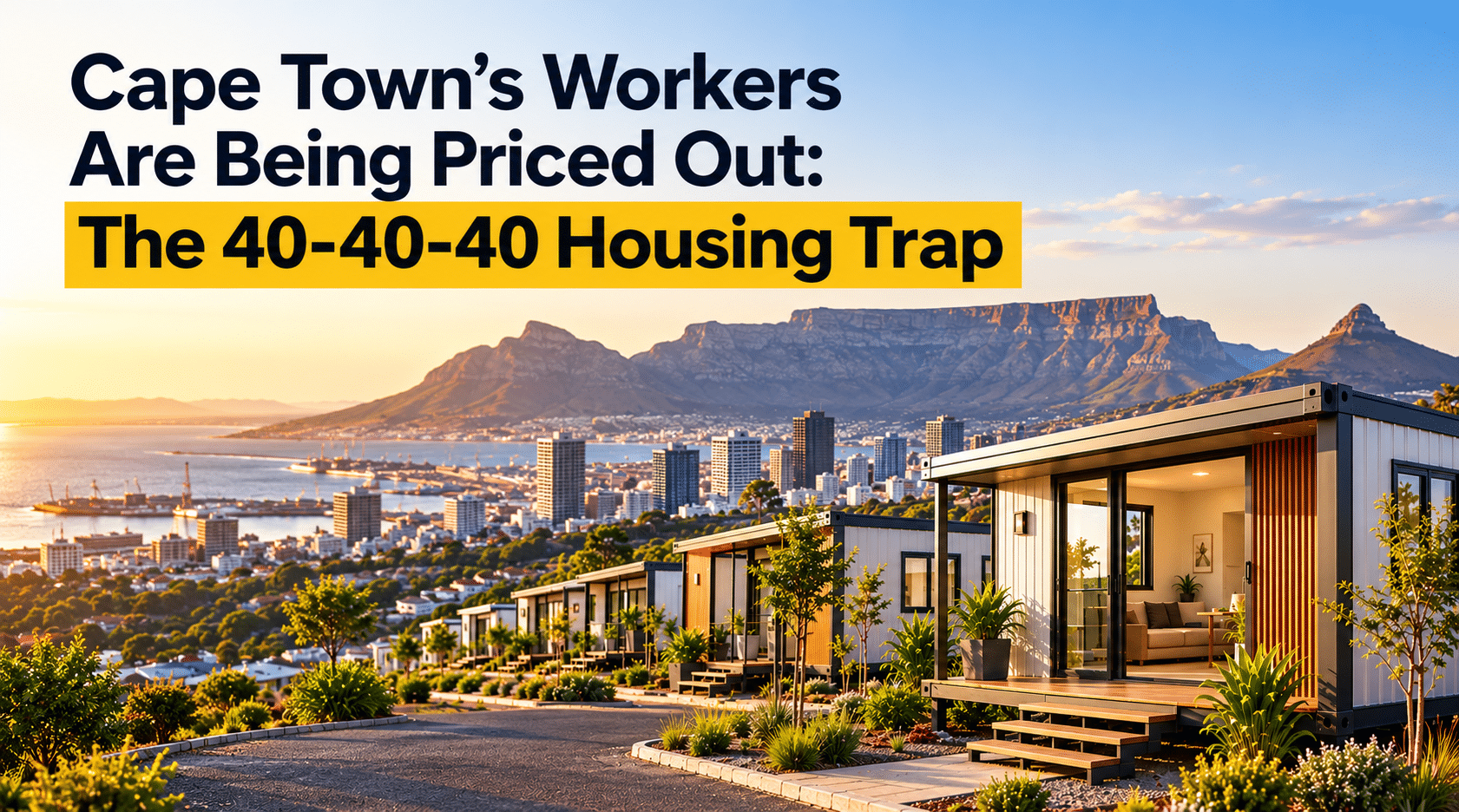
Cape Town is one of Africa’s most beautiful, most desirable, and — for the people who actually keep it running — most unaffordable cities. The nurses, teachers, cleaners, construction workers, drivers, and retail staff who make the city function every day are increasingly unable to live anywhere near where they work. A recent IOL Cape Argus report puts the data behind what every commuter on the N2 already knows: Cape Town’s workers are trapped.
The 40-40-40 Syndrome: What It Means
Urban researchers have given a name to the housing trap that working Cape Town families face. It’s called the 40-40-40 Syndrome:
| The “40” | What It Means | Impact |
| 40 square metres | The approximate size of available affordable housing | Overcrowded — families of 4–6 in a single room |
| 40 kilometres | Distance between affordable areas and employment centres | 2–3 hour daily commute each way |
| 40% of income | Proportion spent on transport to get to work | Nothing left for savings, education, or emergency |
This is not a fringe problem. This is the daily reality for the majority of Cape Town’s workforce.
The Income Numbers Tell the Real Story
| Cape Town residents earning below R22,000/month | 76% |
| Cape Town residents earning below R10,000/month | 58% |
| Residents spending 40%+ of income on transport | Estimated majority of low-income workers |
| Additional housing units Cape Town needs by 2050 | 1 million+ |
The affordability threshold used by housing economists is that housing costs should not exceed one-third of household income. At R10,000 per month — where 58% of Cape Town earns — that means a family should spend no more than R3,333 on rent or a bond. Try finding a decent home in Cape Town for R3,333 a month. For most of the city, it’s impossible. So workers move further out. And then they spend the money they saved on rent on transport instead. The 40-40-40 trap closes around them.
Why This Is Getting Worse, Not Better
Cape Town’s property market has attracted significant investment over the past decade — from domestic buyers escaping Johannesburg, from international remote workers, and from short-term rental platforms. This has pushed property prices and rental rates up sharply in areas that used to be accessible to working-class families.
Meanwhile, the city’s social housing pipeline is moving slowly. Over 128 square kilometres of vacant or underutilised public land has been identified for potential housing development. But land identification is not the same as land delivery — the gap between a land map and a family moving in can be five to ten years of planning, procurement, and construction.
300,000 new residents arrive in South African urban areas every year. Cape Town absorbs a significant portion of that. The city will need over one million additional housing units by 2050. At current delivery rates — and with current constraints on land, finance, and construction capacity — that target looks very distant. Workers can’t wait for 2050. They need somewhere to live now.
Prefab Housing Closer to Work: The Missing Link
The 40-40-40 syndrome has one obvious cure: put affordable housing closer to where people work. A domestic worker who lives 3 kilometres from her employer, instead of 40 kilometres, saves 3+ hours a day and hundreds of rands a week on transport. That time and money goes back to her family. That is a direct, measurable quality of life improvement.
Prefab homes make this possible in a way that conventional construction does not. A Zhauns prefab home can be erected on:
- A plot of land in an existing neighbourhood — no large-scale development required
- A backyard of an existing property — instantly creating a second dwelling unit
- A small serviced site in a township — legal, permanent, and financed through savings or a personal loan
- Agricultural land near a workplace — farm worker accommodation or domestic staff quarters
Because a prefab mobile home starts from R89,900 and can be installed in 12–48 hours, it opens up housing options in locations that conventional construction cannot reach affordably. An employer who wants to retain domestic staff, a farmer who needs worker accommodation, a family that wants to move closer to the city — all of them can act now, without waiting for a housing project to be planned, approved, and built.
What Cape Town’s Workers Actually Need
Based on the 40-40-40 data, the solution has three components — and prefab housing addresses all three:
| Problem | Conventional Housing Answer | Prefab Answer |
| Too far from work | Wait for social housing near employment centres — 5–10 years | Erect a unit on any suitable site near work — weeks |
| Too expensive to rent | Rent assistance programmes — limited and slow | Own a R89,900 home — no ongoing rent at all |
| Too small — overcrowded | Wait for larger public housing unit | Choose your size — bachelor to 3-bedroom available |
The portable buildings South Africa manufacturing model also means that a prefab home isn’t tied to a developer’s timeline. You identify the land. You confirm the site. We deliver and erect. From decision to move-in can be six to eight weeks. Compare that to the years it takes for a social housing project to move from announcement to occupation.
A City That Works for Everyone
Cape Town’s success as a city depends on the people who clean its offices, care for its elderly, drive its buses, build its buildings, and serve in its restaurants being able to live in it — or at least near it. A city that prices out its own workforce is a city that is slowly hollowing itself out.
The housing crisis that is trapping workers in the 40-40-40 syndrome is not going to be solved by a single policy or a single developer. It requires many solutions working simultaneously — social housing, land release, zoning reform, and private-sector innovation. Prefab housing units are one piece of that solution: fast, affordable, permanent, and available today.
If you are an employer, a landowner, a family that has saved and is ready to act, or an investor who wants to provide affordable rental housing close to Cape Town’s employment centres — contact Zhauns. We’ll tell you exactly what we can deliver, in what timeframe, and at what cost. No waiting list. No committee. Just a home.
We also supply prefab spaza shops and retail units for entrepreneurs in these communities, and prefab office structures for businesses that want to establish a presence closer to where their workforce lives.
Sources:
- IOL Cape Argus — Priced out and travelling further: Cape Town’s housing crisis hits workers (Oct 2026): https://iol.co.za/capeargus/news/2026-10-01-priced-out-and-travelling-further-cape-towns-housing-crisis-hits-workers-in-the-pocket/
- EWN — Clearing Western Cape housing backlog could take over 220 years: https://www.ewn.co.za/2026/09/16/clearing-western-cape-housing-backlog-could-take-over-220-years-warns-good-party
- News24 — 500,000 Capetonians wait for houses: https://www.news24.com/southafrica/news/500-000-capetonians-wait-for-houses-as-demand-far-outstrips-state-capacity-hill-lewis-20261005-1178