


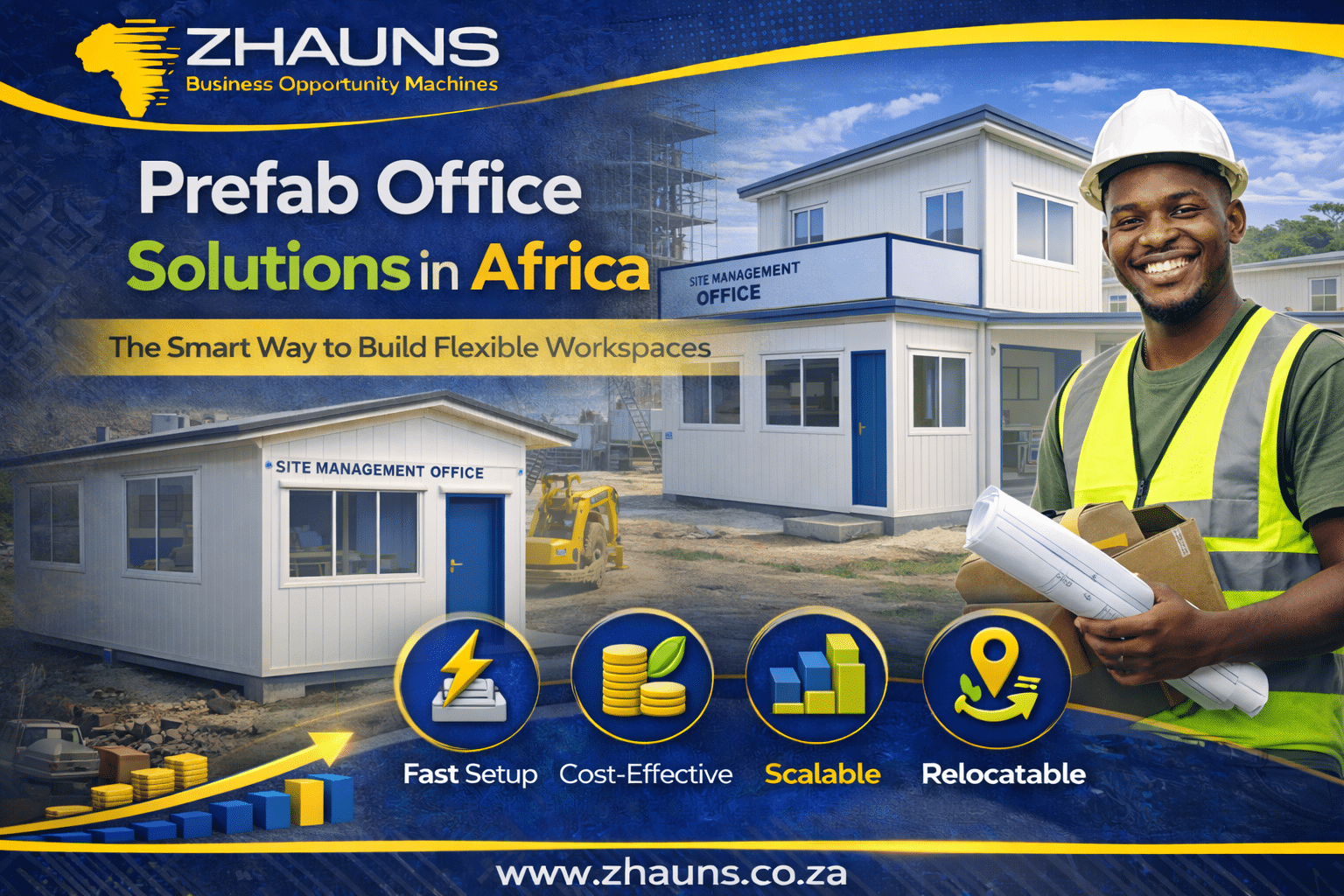
Across Africa, the way businesses operate is changing rapidly.
Construction projects move from site to site. Mining operations shift locations. Logistics hubs expand into new regions. Startups need office space immediately — not months later.
In this fast-moving environment, traditional office construction is no longer practical.
Businesses today need speed, flexibility, and cost control.
This is where prefab office and mobile office solutions are transforming the way companies build and use workspace across Africa.
Instead of investing heavily in permanent buildings, businesses are choosing modular, portable office structures that can be installed quickly, customised easily, and relocated when needed.
With innovative infrastructure solutions from Zhauns, companies can now access ready-to-use office spaces designed specifically for African conditions.
Why Traditional Office Construction Is No Longer Ideal
Building a traditional office involves:
- Long construction timelines
- High labour costs
- Permits and approvals
- Material delays
- Limited flexibility
For businesses operating in dynamic industries, this creates major challenges.
For example, a construction company may need an office for a project that lasts only 6–12 months. Building a permanent structure for temporary use is inefficient and expensive.
This is why more businesses are shifting toward prefabricated office solutions.
What Is a Prefab Office?
A prefab office (prefabricated office) is a workspace that is built off-site in a controlled environment and then delivered ready for installation.
Unlike traditional buildings, prefab offices:
- Require minimal on-site construction
- Can be installed within days
- Offer consistent build quality
- Allow for custom design
With solutions offered by Zhaus
businesses can deploy fully functional office units quickly and efficiently.
What Is a Mobile Office?
A mobile office is a portable workspace designed to be moved from one location to another.
These offices are typically container-based or modular units that include:
- Workstations
- Meeting rooms
- Storage areas
- Electrical systems
- Air conditioning
They function just like traditional offices — but with one major advantage:
They can move with your business.
Why Prefab & Mobile Offices Are Growing Across Africa
Businesses across Africa are choosing prefab offices because they solve real operational problems.
- Speed of Setup
Time is critical in business.
Prefab offices can be:
- Delivered quickly
- Installed within days
- Ready for immediate use
This allows companies to start operations without delays.
- Cost Efficiency
Traditional construction requires high capital investment.
Prefab solutions reduce costs related to:
- Labour
- Materials
- Construction time
- Long-term infrastructure
This makes them ideal for startups and growing businesses.
- Flexibility & Mobility
African markets are constantly changing.
Prefab offices allow businesses to:
- Relocate when projects move
- Expand by adding new units
- Reconfigure layouts easily
This flexibility protects long-term investment.
- Customisation for Business Needs
Every business operates differently.
Prefab office units from Zhauns can be customised with:
- Office partitions
- Reception areas
- Meeting rooms
- Kitchenettes
- Bathrooms
- Branding elements
This ensures that each workspace is aligned with operational requirements.
Industries That Benefit Most from Prefab Offices
Prefab and mobile office solutions are widely used across multiple industries in Africa.
Construction Industry
Construction companies require on-site offices for:
- Project management
- Staff coordination
- Documentation
Mobile offices allow them to move from one project site to another easily.
Mining Operations
Mining projects often operate in remote locations.
Prefab offices provide:
- Administrative space
- Safety control rooms
- Staff facilities
These units can be installed even in challenging terrain.
Logistics & Warehousing
Logistics companies need flexible office space near warehouses and transport hubs.
Prefab offices allow them to:
- Set up quickly
- Expand as operations grow
- Relocate when needed
Government & Infrastructure Projects
Government projects often require temporary offices for:
- Administration
- Planning
- Public services
Prefab units provide a practical and cost-effective solution.
Security & Monitoring Services
Security companies use mobile offices as:
- Control rooms
- Monitoring stations
- Field offices
Designed for African Conditions
Infrastructure in Africa must withstand:
- Extreme heat
- Heavy rainfall
- Dust and wind
- Remote environments
Prefab office solutions developed by Zhauns are designed specifically for these conditions.
This ensures:
- Durability
- Low maintenance
- Long-term usability
From Office Space to Business Ecosystem
One of the biggest advantages of modular infrastructure is that it supports more than just office work.
Businesses can integrate:
- Storage units
- Retail spaces
- Production areas
For example, a logistics company can combine office space with small-scale production using equipment from:
https://zhauns.co.za/manufacturing-machines-for-sale/
This creates a more efficient and self-sustaining operation.
Real Business Example
A company in Durban needed a temporary office while expanding its warehouse operations.
Instead of constructing a new building, they installed a prefab office unit near their site.
Within a week:
- The office was operational
- Staff were working on-site
- Operations continued without interruption
Once construction was complete, the office was relocated to another project.
This shows how prefab infrastructure:
👉 Saves time
👉 Reduces cost
👉 Increases efficiency
Supporting Entrepreneurs & Growing Businesses
Prefab offices are not only for large companies.
They are also ideal for:
- Startups
- Small businesses
- Independent professionals
Through Zhauns support systems:
https://zhauns.co.za/business-academy/
Entrepreneurs can learn how to:
- Set up operations
- Manage business growth
- Scale efficiently
Key Features to Consider When Choosing a Prefab Office
Before investing, businesses should evaluate:
- Required office size
- Number of employees
- Electrical and internet needs
- Security features
- Future expansion plans
Choosing the right structure ensures long-term usability and growth potential.
Why Prefab Offices Are the Future of Workspaces in Africa
The modern business environment demands:
- Speed
- Adaptability
- Cost efficiency
- Scalability
Prefab offices meet all these requirements.
They allow businesses to operate without being tied to one location or fixed infrastructure.