


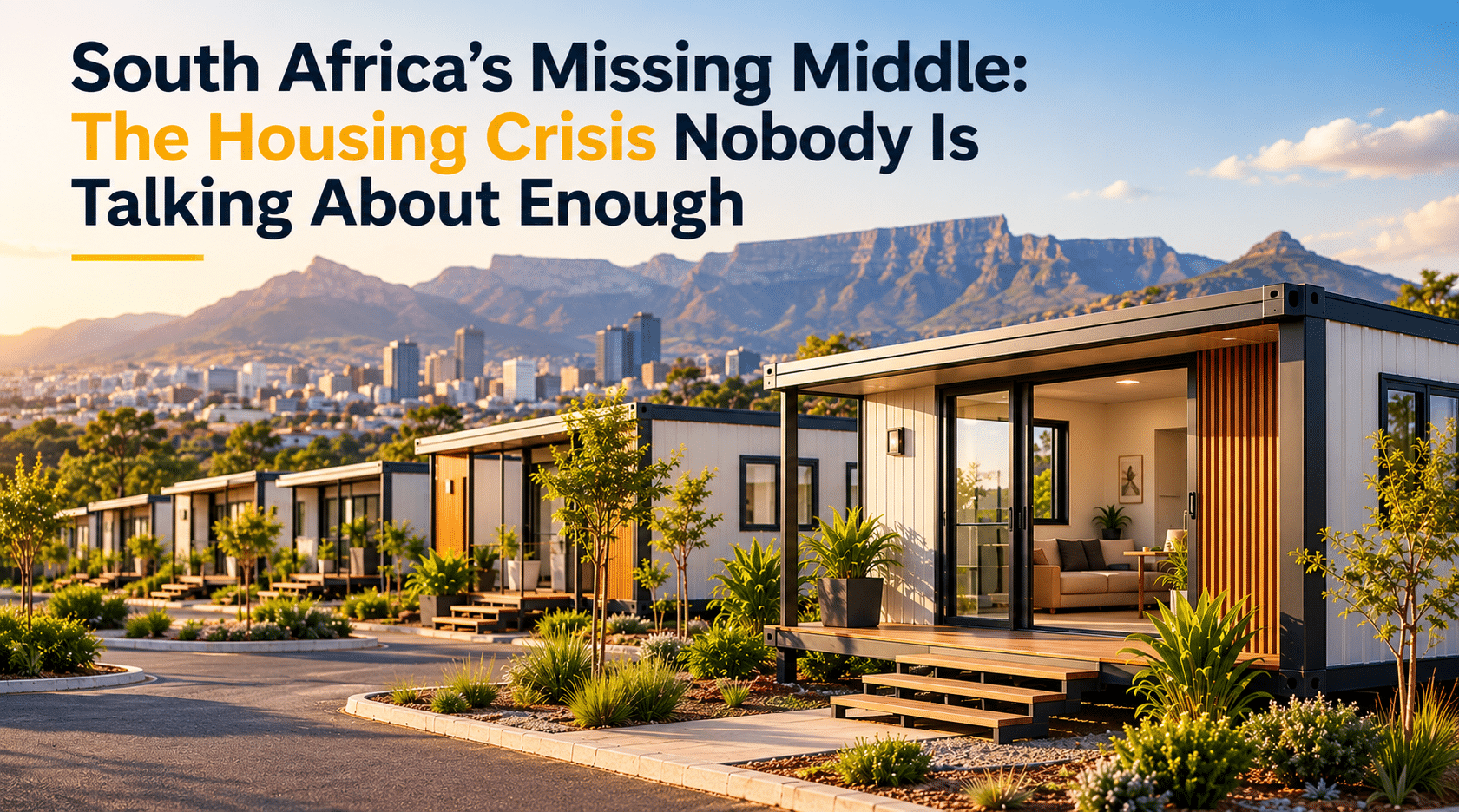
When people talk about South Africa’s housing crisis, the conversation usually jumps straight to informal settlements and the RDP backlog. But there’s another group — roughly 30% of the country’s households — who are equally stuck, equally frustrated, and almost completely ignored by housing policy. They’re called the “Missing Middle”: people who earn too much to qualify for a government subsidy, but too little to afford a standard bank mortgage.
These are South Africa’s nurses, teachers, police officers, security guards, builders, and young professionals. They pay taxes. They keep the country running. And right now, many of them can’t afford a decent home.
Who Exactly Is the Missing Middle?
The Missing Middle isn’t a vague concept — it’s a very specific income group that falls into a gap created by the structure of South Africa’s housing finance system.
| Share of households in the Missing Middle | ~30% |
| Share of individual tax revenue they contribute | 60%+ |
| Total affordable housing backlog (including Missing Middle) | 3.7 million units |
They earn roughly R7,000–R22,000 per month. A government housing subsidy (FLISP or RDP) is designed for people earning below R22,000 — but in practice, the delivery pipeline barely reaches anyone close to that threshold. And a standard home loan from a major bank typically requires a stable income, a good credit record, and a deposit — conditions many in this group struggle to meet even with good intentions and genuine ability to repay.
The result? They rent — often at high cost, in areas far from work, in someone else’s property — for years. Or they build informally, piece by piece, on land they don’t own. Or they wait. And wait. According to FAnews, the demand for affordable housing in this segment is described as ‘both deep and durable.’ Meaning it’s not going away.
Why the System Wasn’t Built for Them
South Africa’s housing finance system has two lanes: a subsidy lane for low-income households, and a mortgage lane for middle-to-high income earners. The Missing Middle falls between the two — earning just enough to disqualify from the subsidy, not quite enough to comfortably service a bond.
Banks have historically viewed this group as too risky. Not because they don’t repay debt — millions of them repay personal loans, car payments, and store credit every month without fail. But because the conventional home loan product isn’t designed for their income profile, their employment structure, or the land they have access to.
The 2026 National Budget acknowledged this gap — the government committed over R1 trillion to infrastructure and established blended-finance vehicles. But even if those mechanisms work perfectly, implementation takes years. The 3.7 million families in the affordable housing backlog can’t wait for a financial instrument to be designed, capitalised, and deployed. They need a home. Now. That’s where affordable prefab mobile homes change the equation.
What Prefab Offers the Missing Middle
Here’s the honest arithmetic: a Zhauns prefab home starts from R89,900. A nurse earning R15,000 per month, saving aggressively for 12–18 months, or pulling together a family stokvel contribution, can reach that figure. A personal loan from most major banks covers that amount comfortably at reasonable repayment terms.
The missing middle doesn’t need a government subsidy. They don’t need a 20-year bond. They need a quality home they can access now, at a price they can actually reach within a reasonable timeframe. Our prefab housing units Africa deliver exactly that — a permanent, insulated, 25–40 year lifespan structure erected in 12–48 hours on your own land or a leased plot.
| Option | Income Requirement | Timeline | Key Barrier |
| RDP subsidy | Under R3,500/month | Decades — 220 years to clear WC backlog | Not qualifying, or waiting too long |
| FLISP subsidy | R3,501–R22,000/month | Unknown — dependent on project pipeline | Slow delivery, limited land |
| Bank mortgage | R15,000+ stable income | 3–6 months (if approved) | Deposit, credit score, affordability |
| Zhauns prefab home | Any income + R89,900 | Weeks — 12–48 hours installation | Find land, save the capital |
Prefab isn’t a compromise. It’s a shortcut around a broken system. While the government works on fixing the pipeline — and it will take time — the Missing Middle has a path to homeownership today through portable buildings South Africa. No waiting list, no bank approval anxiety, no decade-long queue.
It’s Not Just About Having a Roof
Owning a home changes everything for a family. It ends the cycle of rental dependency. It creates an asset that can be extended, improved, and passed on. It gives children a stable address for school registration. It allows a family to save the money previously spent on rent and direct it towards business, education, or investment.
South Africa’s Gini Coefficient — at 63, the highest in the world — reflects extreme wealth inequality. One of the single most effective mechanisms for reducing that inequality over time is expanding homeownership to the Missing Middle. Every family that moves from renting to owning a prefab mobile home is a small step in that direction.
The Missing Middle Doesn’t Have to Stay Missing
The policy debate will continue for years — blended finance, public land release, subsidy reform, zoning changes. These are real and important conversations. But they move slowly.
If you’re a nurse, a teacher, a police officer, or a young professional who has been looking at the housing market and wondering if you’ll ever own a home — you don’t have to wait for the policy debate to resolve. A prefab home from Zhauns is available now, at a price the Missing Middle can reach, with a delivery timeline that is measured in weeks, not years. Contact us for a no-obligation quote and let’s talk about what’s possible on your budget and your land.
Sources:
- FAnews — South Africa’s housing crisis has moved into the middle: https://www.fanews.co.za/article/investments/8/general/1133/south-africa-s-housing-crisis-has-moved-into-the-middle/43588
- IOL — Housing crisis deepens as backlog exceeds 2 million homes: https://iol.co.za/business/property/2026-03-24-housing-crisis-deepens-in-south-africa-as-backlog-exceeds-2-million-homes/
- BizCommunity — Can 2026 budget reforms finally solve SA affordable housing problem: https://www.bizcommunity.com/article/can-2026-budget-reforms-finally-solve-south-africas-affordable-housing-problem-844403a